German

Policy Paper Vol. 5

Visuel
Cover Policy Paper 5
Abstract

Depending on location, European border regions can look back on several decades of development in their histories of cooperation. For the Franco-German region this stretches back to the post-World War 2 reconciliation between the two countries, for the German-Polish borderlands to the raising of the Iron Curtain and the reunification of Germany in 1990. It is, however, easy to forget how fragile cross-border relations can still be: something the Covid pandemic, with its limping crisis management, brought powerfully home in the months of and after spring 2020. Poor cross-border communications and inadequate foresight as to their effects exacerbated the problems – old as well as new – caused by re-erecting long disused checkpoints and closing borders. In the present time of polycrisis it is more than ever important to review the Covid era and to analyze the nature and timescale of resilience in cross-border cooperation.

In a project based on empirical surveys and funded by the German-Polish Science Foundation, the four authors of the present policy paper outline a number of development perspectives for the Franco-German and German-Polish borderlands. Differentiating among resilience factors according to their capacity for resistance, adaptation, and transformation, practical recommendations are given for the enhancement of crisis management in both regions. The recommendations cover four areas:

  • Communication between decision-makers must be improved and widened at all levels – vertical, horizontal, and diagonal – taking account of varying structures and responsibilities in the face of specific borderland challenges. Informal as well as formal communications are of central importance, not only in times of crisis but permanently. Suitable provision should also be made for cross-border residents.
  • Of central importance is the growth of responsible cooperation on the basis of familiarity and trust, political will and mutual transparency. Borderland-specific measures can play a major role here, as does the reinforcement of intercultural competence.
  • Key players and structures should be familiar to people across all levels of action: this can provide a basis for common cross-border growth. Suitable measures for improving knowledge transfer, disseminating good practice, and developing scenarios for response to future crises include the exchange of personnel and regular practice sessions. Apart from crises, such measures foster relations on an everyday level. All of this presumes the existence of adequate funding for border regions.
  • The EU perspective on borderlands as ‘living laboratories of European integration’ requires that their potential for the development of the EU be taken seriously and vitally enacted. The opportunities offered by a Europe of open frontiers should be actively publicized – also as a means to anticipate and counter any feelings of cultural or national resentment. 
 

Working Paper Vol. 20

Visuel
Cover
Abstract

Despite the increased discourse on the complexity of borders, there are hardly any references in the academic debate as to what exactly complex borders mean or complexity-oriented border research. This paper starts here and discusses the promising relationship between complexity thinking and border research. To this end, it explains what is currently qualified as complex in border research and what understanding of complexity can be found there. The core ideas of complexity thinking are then presented and linked to the ordering and ordered principle of the border. Building on this, border research approaches and methodologies are identified that can be considered enablers of the complexity perspective and, thus, as starting points for complexity-oriented border research.

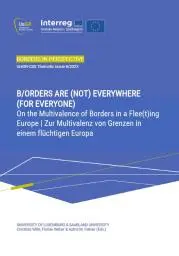
Thematic issue Borders in Perspective Vol. 8

Visuel
Thematic issue Borders in Perspective Vol. 8
Abstract

While the materialities and functionalities of borders have changed drastically in recent decades, the ordering principle of the border persists. At the same time, the selective character of borders is emerging with a clarity that has hardly been seen in Europe before. This is the point of departure for the issue papers, which discuss the observation that borders do not have the same significance for all people. For this purpose, the authors work with the concept of multivalence, which assumes that borders have social valences or relevances that differ regarding certain groups of people. The thematic issue with case studies of governance, flight, reporting, film, and literature shows multiple valences of borders, which stand for inequalities and refer to powerful cultural orders.

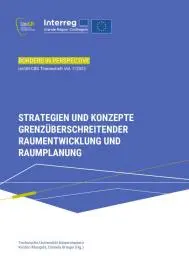
Thematic issue Borders in Perspective Vol. 7

Visuel
Thematic issue Vol. 7
Abstract

In border areas, there is a special need for cross-border coordination between the stakeholders of spatial development and spatial planning with regard to spatially relevant challenges and future oriented development processes. The process of creating and implementing cross-border spatial development concepts requires intensive communication and cooperation across borders. However, these can make an important contribution to a coordinated cross-border spatial development and thus bundle resources as well as efficiently direct them to coordinated measures and projects. In addition to this added value of cross-border cooperation, however, there are also numerous points of friction and obstacles, which are caused, among other things, by different planning traditions and cultures, administrative systems and responsibilities, or also concern a lack of knowledge about planning instruments in the cross-border context. In cross-border spatial planning and development practice, these obstacles and the existing spatial challenges can also be countered by sub-spatial or subject-specific cooperation institutionalized and organized at different spatial levels. In this thematic issue, strategies and concepts from cross-border spatial development are presented and highlighted, which deal with different topics of spatial development, reflect a spectrum of cross-border forms of cooperation and organization and discuss the added value.

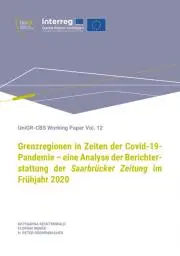
Working Paper Vol. 12

Visuel
Working Paper 12
Abstract

The year 2020 challenged and put into question seeming certainties. The nation states responded to the spread of the coronavirus with varying restrictions of freedom(s), as well as temporary reintroduction of border controls or closures. 35 years after the signing of the Schengen Agreement, the issue of internal border controls within the EU resurfaced – with varying effects on border regions. Buildung upon a constructivistic perspective and based on a qualitative content analysis of newspaper articles of the Saarbrücker Zeitung in spring 2020, the Working Paper traces central discussion processes with a spatial focus on the cross-border area of the Greater Region. Our findings show that reports on securing border crossings outweigh those about reopening borders, underlining the effect of border closings as a sudden rupture with major effects on the lives of border residents, especially cross-border commuters. The actors demand a significant expansion and intensification of cross-border communication and cooperation in response to these experiences.