Program Atelier Bordertextures
26 June 2019
Border Aesthetics: Visibility and Invisibility at the US-Mexico Divide
Markus Heide (Uppsala University)
26 June 2019, 16:00-18:00
Saarland University, Campus Saarbrücken
In the 80s and 90s artists and writers who engaged in what today is referred to as “border art” had a strong focus on forms of cultural blending and mixing as well as liberating concepts of de-categorization. Some of these artists and writers highlighted the utopian potential of border space. Their literary and artistic work has contributed to theorizing various forms of mixing. Their border art inspired postcolonial concepts of hybridity, metissage and mestizaje. Following this period, in the late 90s and particularly after 9/11, surveillance became a concern in art that critically explored border paradigms. More recently, the focus of border art shifted towards questions of violence: narco violence, feminicide, immigration, but also structural violence that established criteria defining who is allowed to cross the border and who is not. The lecture will discuss intersections of politics and aesthetics in the contemporary US-Mexico borderlands.
Markus Heide is associate professor at the Swedish Institute for North-American Studies at Uppsala University. His recent research concentrates on Inter-American relations (USA, Canada, Mexico) and the US-Mexico border. In this context he co-edited Hemispheric Encounters: The Early United States in Transnational Perspective (2015) and published academic contributions on border film, border art, and “narcocorridos” in the US and Europe. In 2017 and 2018 he was visiting research fellow at the Center for Iberian and Latin American Studies at UC San Diego, doing research and field work on The US-Mexico Borderlands as Contested Space: Film, Art, and Popular Culture.
6 December 2018
Globalized Borders: An Archaeology of Border Theory, Border Poetics and Border Aesthetics
Johan Schimanski (University of Oslo & University of Eastern Finland)
6 December 2018, 15.30-17
University of Luxembourg, Campus Belval
Maison du Savoir, salle 4.510
Border Theory, Border Poetics and Border Aesthetics are theoretical formations which inhabit the interstices between Literary, Cultural and Border Studies in the wake of poststructuralism, postcolonialism and Chicana/o studies. In this lecture I will be tracing an archaeology of the theoretical concerns, concepts and interdisciplinary engagements which have developed in these approaches to borders. What may such an archaeology tell us about possible future developments in the study of borders and culture in a world in which borders have become globalized, such as the recent formation of the Border Textures concept?
Johan Schimanski is Professor of Comparative Literature at the University of Oslo, Research Head at the Department of Literature, Area Studies and European Languages there. He is also affiliated to the University of Eastern Finland as a Professor of Cultural Encounters. Recent publications include the collaboration Border Aesthetics: Concepts and Intersections (2017). A book of border theory translated into German will be published in 2019.
13 June 2018
Migrierende Grenzen und Zeitverschiebungen: Zum Zusammenhang von Temporalitäten und Grenzüberquerungen in Europa
Carolin Leutloff-Grandits
Europe University Viadrina Frankfurt (Oder)
13 June 2018, 4-6 p.m.
Building B 3.1, Room 011 (Sitzungssaal)
Saarland University, Campus Saarbrücken
[Migrating Borders and Changing Times: Temporalities and Border Crossings in Europe (Talk in German)]
Dr. Leutloff-Grandits's talk will present interrelations between borders, border crossings and temporalities from theoretical perspectives before exploring connections between theoretical approaches and practical implications of migration and flight. The presentation is going to discuss temporalities in relation to borders and ordering processes as well as the situatedness of migrants in time.
Dr. Carolin Leutloff-Grandits holds a PhD in social anthropology. Her research is centered on questions of migration, family, social security and implications of borders with a special focus on the geographical areas of Croatia, Kosovo, Germany and Austria. After receiving her PhD in 2015 from the Max-Planck-Institute for ethnologies in Halle/Saale, she worked for different research projects at Graz University and taught at the University of Vienna. Since April 2018 she is scientific coordinator at the Viadrina Center B/ORDERS IN MOTION at the Europe University Viadrina in Frankfurt / Oder.
22 February 2018
Infrastrukturen der Grenze
Hannes Krämer (European University Viadrina Frankfurt/Oder)
February 22, 2018
3.30-5.00 p.m.
University of Luxembourg
Campus Belval | Maison du Savoir | salle 3.120
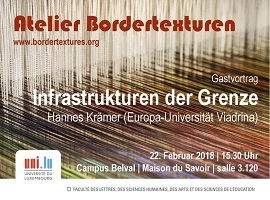
[Infrastructures of the border (Talk in German)]
Borders do not exist out of nothing; they require material and symbolic creation processes. They thus rely on infrastructures, i.e. on the efficacious and often invisible principles of connection and separation, which, as some kind of “substrate,” offer the basis for social processes. The understanding of borders as infrastructural formations allows accessing the individual dimensions of the multiple bordering processes as well as a description of the relationality of border dimensions. This lecture reconstructs the potential of the concept of infrastructure for the analysis of border and boundary processes and illustrates the praxeological reformulation of such an understanding of a “border.”
Dr. Hannes Krämer is scientific coordinator of “Grenzforschung” (Border Studies) and director of the research group “Border & Boundary Studies” at the Viadrina Center B/ORDERS IN MOTION. He studied social sciences and communication and received his doctorate with a thesis on an ethnography of creative labor. His research fields are border studies, practice theory, labor and organizational research, mobility studies, and time research.
7 June 2017
The Work of Global Border Writing
Claudia Sadowski-Smith (Arizona State University)
7 June 2017, 4-6 p.m.
Saarland University, Campus,
Building C 5 3, room 119
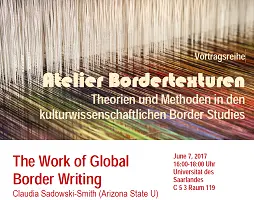
This presentation places US-Mexico border theory in the larger context of global discourses about contemporary human border crossings. Claudia Sadowski-Smith will discuss how a growing body of writing about bordercrossings to the United States and the European Union complicates the prevailing focus in American Studies on the relationship of a particular population to a specific geographical border.